Everest Base Camp Trek
-
The Everest Base Camp trek is a 14-day classic adventure in Nepal covering approximately 130 km or 80 miles from Lukla to Everest Base Camp and back to Lukla.
A challenging high altitude, non-techical trek taking hikers to the south base camp of Mount Everest with 10 km of trekking per day.
Everest Base Camp (5364 m), Kalapathar (5550 m), and Nangkartshang Peak (5083) are the three highest trekkable places on this route.
While the highest overnight stay is Gorakshep (5140 m) before approaching Everest Base Camp.
Surrounded on all side by some of the highest mountains in the world, Everest Base Camp Trek in Nepal is the most exhilarating and the most scenic.
14-days days of hiking through some of the most varied scenery that one will encounter in the entire Himalayas.
A trek like no other that offers the onlooker unparalleled views of some of the highest mountains in the universe with breath taking sceneries, and awesome mountain views.
-
INDIA
Farouttrek
Upper Chiboo Approach Road,
Kalimpong-734301
Darjeeling, West Bengal
Bigfoottreks & Adventures,
Regn.#:10/TD/10/TA
Yuksom Bazaar,
P.O. Gyalshing-Sikkim
NEPAL
Climb High Himalaya,
1st.Floor, Sagarmatha Bazaar,
Mandala Street, Kathmandu-Nepal - CALL US
- INDIA: Mr.Fabian - +91 - 9933975902
- NEPAL: Mr.Dawa - +977-9803001116
- WhatsApp: 9933975902
- info@farouttrek.com
Everest Base Camp Trek – Close encounter with the world’s highest mountains
The Everest Base Camp Trek (EBC) is a challenging, non-technical high-altitude trek for advanced hikers, covering approximately 130 km in 14 days with an average of 10 km of trekking per day for an average hiker. It’s also a hike among the tallest Himalayan mountains in the world for beginners who are well trained at high altitude.
Everest Base Camp Trek starting from Kathmandu with a flight to Lukla and back to Kathmandu can be done within fourteen days for an average hiker. But for a seasoned hiker, it is possible within twelve days without the rest days at Namche Bazaar and Dingboche.
In a period of 14 days, one can trek from Lukla (2840m) to Kalapathar (5550m), to Everest Base Camp (5364m) & return to Kathmandu. For a person who loves Hiking and adventure, the Everest Base Camp Trek is not just a trek but a journey to the foot of Mt. Everest, the highest peak in the world.
On every hiker’s bucket list, the Everest Base Camp Trek (EBC) is truly a classic trek, with views of the highest mountains in the world right from day one.
Surrounded by the highest mountains in the world, you will bask in this incredible mountain scenery before hiking back to little-visited Phortse village, ending the trek in Lukla and flying out to Kathmandu.
Best Side Treks and Acclimatization Hikes on the Everest Base Camp Trek
The side trek to the twin villages of Khunde and Khumjung (3790m)—is the most popular and rewarding day hike undertaken during an acclimatization day in Namche Bazaar on the Everest Base Camp trek.
Located in a high valley just beneath the sacred mountain Khumbila (5761 m), these traditional Sherpa villages offer a quieter, more cultural experience compared to bustling Namche Bazaar.
Also, do not forget to visit the Khumjung Monastery famous for housing the preserved scalp of the Yeti.
For the adventurous one can also take a day hike to Thame Village, and when in Thame visit the old monastery there. The Day Hike to Thame and back to Namche takes an entire day.
Side Trek to Chukung
On the standard Everest Base Camp (EBC) trek and staying in Dingboche for an acclimatization day, the 4-5 km side trek to Chukung (4730 m), and return to Dingboche by afternoon is a good option.
If feeling strong, climb Chhukung Ri (5,550) for panoramic views of the massive Lhotse South Face, Nuptse, and Baruntse.
Hiking to Nangkartshang Peak above Dingboche
If trekking to Chukung Village is a little tiring on your legs, hike up to Nangkartshang Peak (5083 meters/16,676 feet), sometimes called Nagarjun Peak, just above Dingboche village.
It is a spectacular and challenging acclimatization 2-4 hour round trip on the Everest Base Camp (EBC) trek, offering spectacular close-up panoromic views of Nuptse, Lhotse, Thamserku, Amadablam, Makalu and a host of smaller peaks of the Everest range.
Everest Base Camp & Kalapathar
From Gorakshep its a 8 km round trip along the Khumbu Glacier to Everest Base Camp (5364m/17,598ft), but do not get overatken by the short distance. Despite the modest distance, the 50% less oxygen compared to sea level, and rough terrain make it physically demanding.
While enroute you will reach a point from where you get a spectacular birds eye view of the Everest Base Camp dotted with tents at the edge of the Khumbu Ice Fall. The sight of the Khumbu Glacier, Nuptse and the west shoulder of Everest is incredible.
From Goorakshep take an early morning hike to Kalapathar-5545 m, the highest point and the ultimate viewpoint on the Everest Base Camp Trek. Its a 4 km and 3-4 hour round trip and offers close up views of Mount Everest and its entire range, the Khumbu Glacier, and the Khumbu icefall.
Amadablam – the most photographed mountain.
Few mountains shape the scenery of the Everest Base Camp route as dramatically as Ama Dablam. This 6000+ m peak is strikingly beautifull, and most photographed mountain on this route.
As trekkers move deeper into the Khumbu region, its appearance constantly changes. From one village it may appear sharply pointed and symmetrical, while from another angle its ridges, hanging glaciers and steep rock faces become more prominent.
This changing perspective makes Ama Dablam one of the most memorable mountains seen during the Everest Base Camp Trek, and a major attraction for trekking photographers. This in itself is a privelage to watch the mountain in different forms from different places.
Trek Grade
The Everest Base Camp Trek is a non-technical moderate to challenging trek from Lukla (2,805m/9,202ft) to Everest Base Camp (5364 m/17,593 ft), and hikers do not need climbing or mountaineering skills to do this trek.
However, the high altitude, daily endurance demands, and cold weather make it physically rigorous.
Who Can Do It?
Anyone with good cardiovascular fitness, strong leg endurance, and proper altitude preparation can successfully complete the Everest Base Camp trek.
Prior high-altitude experience or multi-day hiking practice is recommended, but motivated first-time high-altitude trekkers complete it regularly by maintaining a slow, steady pace with proper acclimatization rest days.
View of Everest from the Everest Base Camp
Mount Everest is visible from Kalapathar, Tengboche and from the Everest view Hotel above Namche Bazaar. From the Base Camp you will only be able to see the western Shoulder of Everest, Nuptse, Pumori, Lobuche and Lingtren.
Accommodation
Accommodation on the Everest Base Camp (EBC) route is in tea houses and small, family-run lodges.
These lodges offer unheated twin share rooms with two simple wooden beds with foam mattresses, pillows, and blankets or quilts, and common bathroom.
You will need a sleeping bag that can withstand -10 to -20 degree celcius, as room temperature drops below freezing at higher altitudes.
However, lately upgraded rooms with an attached bathroom are available in places like Lukla, Phakding, Namche Bazaar, and Dingboche.
These lodges and tea houses have inhouse restaurant, and they expect the hikers to buy food from their restaurant.
Food on the Trek Route
The tea houses and the lodges enroute to the Everest Base Camp serve a mix of traditional Sherpa, Nepalese, and basic Western dishes, though the variety decreases as you go higher.
Dal (lentil soup) Bhat (steamed rice) and vegetable curry is the undisputed food on the trek route. It is freshly cooked, nutritionally balanced, and all teahouses offer free refills.
Breakfast is normally Tibetan Bread (thick flour bread deep-fried in oil) or chapatis served with jam or honey.
Porridge served plain or with apple, banana, or honey.
Eggs boiled, scrambled, poached, or mixed with cheese omelets.
Plain pancakes, or with cinnamon, banana, or chocolate pancakes.
The restaurants also offer on order cheese pizza, macaroni, pasta and vegetable dumplings (momos) too.
Almost all the tea houses and lodges has a bakery, and they provide bakery products too.
Drinks & Beverages
Hot lemon tea, ginger-honey-lemon tea, masala chai, black or green tea, hot chocolate, and instant or brewed coffee are available in the tea house and lodges, and are available on demand.
Bottled water is available but becomes expensive as you go higher (up to $3–$5 per liter at Gorakshep). Tea houses and lodges have taps and you can use water for drinking, but make it a point to use water purifier/UV device.
Since all supplies must be flown into Lukla, and carried up by porters or yaks, food prices increase steadily as you trek higher.
Threfore, allocate around $30 to $45 USD per day for meals, snacks, and hot drinks along the route.
Electricity & Wi-Fi
The lodges have electricity, and charging phones, power banks, and camera batteries costs extra about NPR.300 per device or per hour, and becomes expensive as you trek higher up.
WIFI is available throughout the route. You will have to buy prepaid cards like Everest Link which cost about NPR.500 for 24 hours, though speed and reliability drops after you cross Tengboche.
Best Season
The absolute best season for the Everest Base Camp (EBC) trek are the spring season from March to May, and the post monsoon, the autumn season from late September to November.
These seasons are the peak times and will see plenty of crowds on the trail.
December is also a good time to do this trek if you can with stand freezing temperatures, but fewer crowds throng the trail during this time.
Evacuation in case of Emergency
After Phaplu the Khumbu region has no road connectivity therefore, evacuation by helicopter in case of emergency is the standard and fastest method.
Rescue helicopters operate across the Everest region, up to Gorakshep and Everest Base Camp depending on the weather conditions.
Helicopters require clear visibility and manageable wind conditions. If there is cloud cover or high winds helicopters will not be able to land.
In such cases the sick and the injured are manually transported down to lower altitude with the help of porters.
A single helicopter evacuation typically costs between $2,500 and $5,000 depending on pickup location and destination.
Therefore, comprehensive insurance policy is a must on the Everest Base Camp Trek, as this will cover the cost of evacuation by helicopter.
TRIP FACTS
- Type of Trek: Lodge Trek.
- Total No. of Days: 14 Days.
- Trekking Days: 14 Days.
- Trek Grade: Moderate to Difficult.
- Duration: 13 Nights/14 Days.
- Maximum Sleeping Altitude: 5140m/16,863ft(Gorakshep).
- Maximum Hiking Altitude: 5550m/18,208ft(Kala Patthar Peak).
- Best Season: Mar-June and Oct-Dec.
Everest Base Camp Trek Itinerary
Day 01: Fly Kathmandu to Lukla(2800m). Trek to Phakding (2625m/8Km-3Hrs). Lodge.
Day 02: Trek to Namche Bazaar (3440m/12Km-5Hrs). Lodge.
Day 03: Rest and acclimatization day with optional hikes to Khunde Khumjung. Lodge.
Day 04: Trek to Thyangboche Monastery (3860m/12Km-6Hrs). Lodge.
Day 05: Trek to Dingboche (4410m/11Km-6Hrs). Lodge.
Day 06: Rest and acclimatization day at Dingboche. Optional hike to Chukung (4730m/8Km-5Hrs).
Day 07: Trek to Lobuche (4910m/9Km-5Hrs). Lodge.
Day 08: Trek to Gorakshep. Continue Trek up the Khumbu Glacier to Everest Base Camp (5364m/15 kms). Return to Gorakshep for overnight (5140m). Total 8-9 hours.
Day 09: Morning climb to Kala Pathar(5550m) for panoramic views of Mt.Everest & Khumbu Glacier (4 kms/4hours return). Afternoon return trek to Pheriche (4240m/10 kms-5 hours). Lodge.
Day 10: Trek to Phortse Village (3680m/10Km/5Hrs). Lodge.
Day 11: Trek to Namche (3440m/14Km-6Hrs).
Day 12: Trek to Monjo (2835m/8Km/3Hrs). Lodge
Day 13: Trek to Lukla (2800m/16Km/6Hrs). Lodge.
Day 14: Fly Lukla to Kathmandu. End of Trek.
—– o0o —–
EVEREST BASE CAMP TREK COSTS: US$1200 per Person
- Kathmandu-Lukla-Kathmandu Airfare – US$450/person(subject to change without prior notice).
- Kathmandu-Lukla-Kathmandu Airfare for Indian Nationals: IRs.13000/person
- Airfare extra as applicable & is subject to change without prior notice
—– o0o —–
TREK COST INCLUDES:
- Lodge accommodation (twin share rooms);
- Trek guide, porter/s to carry luggage;
- Sagarmatha National Park Fees.
- Khumbu Entry Fees.
- Contribution to guide transport;
- Guide/porter insurance costs;
COST DOES NOT INCLUDE:
- Hotel Stays in Kathmandu.
- Nepal visa fees (US$ 30);
- Kathmandu-Lukla-Kathmandu Airfare
- Sleeping bag (can be hired in Kathmandu);
- Personal clothing/equipment;
- Meals in Kathmandu;
- Tips;
- Client insurance of any kind;
- Cost of evacuation (if any)in Case of emergency;
- Bottled/alcoholic drinks;
- Snacks/desserts;
- Tea/coffee – other than at breakfast;
- Airport taxes; Expenses of personal nature.
—– o0o —–
Our trek price includes basic rooms in local trekkers lodges which have simple 2 bedded rooms with common toilets/showers. In some places like Lukla, Namche Bazaar and Kumjung some newly upgraded lodges have rooms with attached toilets-showers but this will cost extra (about US$ 20-30 per room per night). Some lodges now offer even better rooms but can cost even more.
NEPAL TOURIST VISA
- Nepal visa is readily available on arrival at the International Airport in Kathmandu and all other entry points to Nepal.
- 2 passport photos will be required.
- Single Entry visa: US$ 30 per visa (valid for 60 days).
- Multiple Entry visa: US$ 80 per visa (valid for 150 days).
- Nepal Visas are also available in all Nepalese Embassies and Consulates.
- No Visa is required for Indian Citizens to enter and Travel in Nepal
—– o0o —–
Note: The above itinerary is a sample intended to give you a general idea of the likely trip schedule. Numerous factors such as weather, road conditions, physical ability of the participants etc. may dictate itinerary changes either before departure or while on the trail. We reserve the right to change this schedule in the interest of trip participant’s safety, comfort and general well being.
(All relevant Terms & Conditions apply).
EVEREST BASE CAMP TREK COSTS: US$1120 per PERSON
- Kathmandu-Lukla-Kathmandu Airfare – US$450/person(subject to change without prior notice).
- Kathmandu-Lukla-Kathmandu Airfare for Indian Nationals: IRs.13000/person
- Airfare extra as applicable & is subject to change without prior notice
—– o0o —–
TREK COST INCLUDES:
- Lodge accommodation(twin share rooms);
- Trek guide,porter/s to carry luggage;
- Fixed meals (breakfast/lunch/dinner);
- Trek permit & Park fees;
- Contribution to guide transport;
- Guide/porter insurance costs;
- Domestic flight cost extra as applicable.
COST DOES NOT INCLUDE:
- Hotel Stays in Kathmandu.
- Nepal visa fees (US$ 30);
- Kathmandu-Lukla-Kathmandu Airfare
- Sleeping bag (can be hired in Kathmandu);
- Personal clothing/equipment;
- Meals in Kathmandu;
- Tips;
- Client insurance of any kind;
- Cost of evacuation (if any)in Case of emergency;
- Bottled/alcoholic drinks;
- Snacks/desserts;
- Tea/coffee – other than at breakfast;
- Airport taxes; Expenses of personal nature.
—– o0o —–
Our trek price includes basic rooms in local trekkers lodges which have simple 2 bedded rooms with common toilets / showers. In some places like Lukla, Namche Bazaar and Kumjung some newly upgraded lodges have rooms with attached toilets-showers but this will cost extra (about US$ 20-30 per room per night). Some lodges now offer even better rooms but can cost even more.
—– o0o —–
(All relevant Terms & Conditions apply).


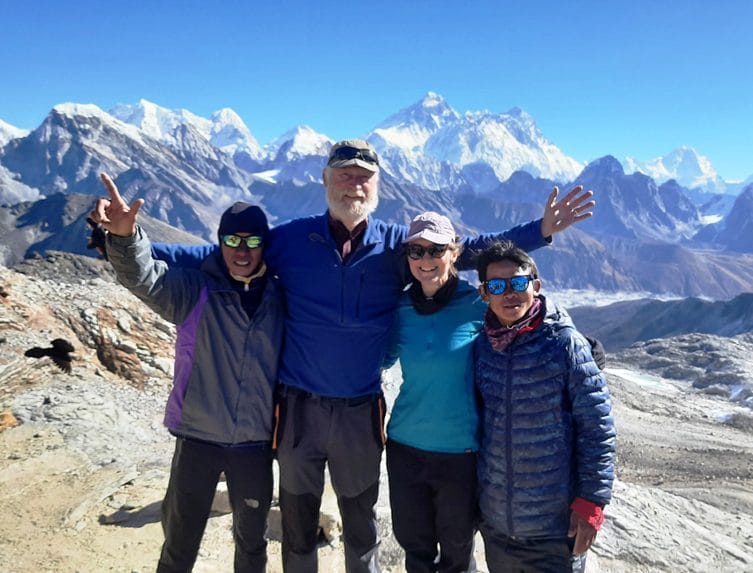

Please Don’t Take Our word for It, Read What Hikers Worldwide Have to Say About Us.